

I’ve developed a method to convert all my baking recipes with all-purpose flour (or self-rising flour) into gluten-free recipes. You only need to make a few adjustments to enjoy all the taste and almost the same texture in all my muffins, bread, scones, brownies, and cakes!
You must adjust the recipe according to the instructions provided below.
Gluten-Free Flour Conversion Tool
Determine the exact mixture to replace wheat flour with a customized GF blend.
1. Select Recipe Type
2. Wheat Flour Amount to Replace
3. What type of flour does the recipe call for?
Your Gluten-Free Flour Mixture
You need all of the below:
Select your options above to see the required ingredients.
* Amounts are rounded for practical use. Smallest measurable US amount is 1/8 tsp.
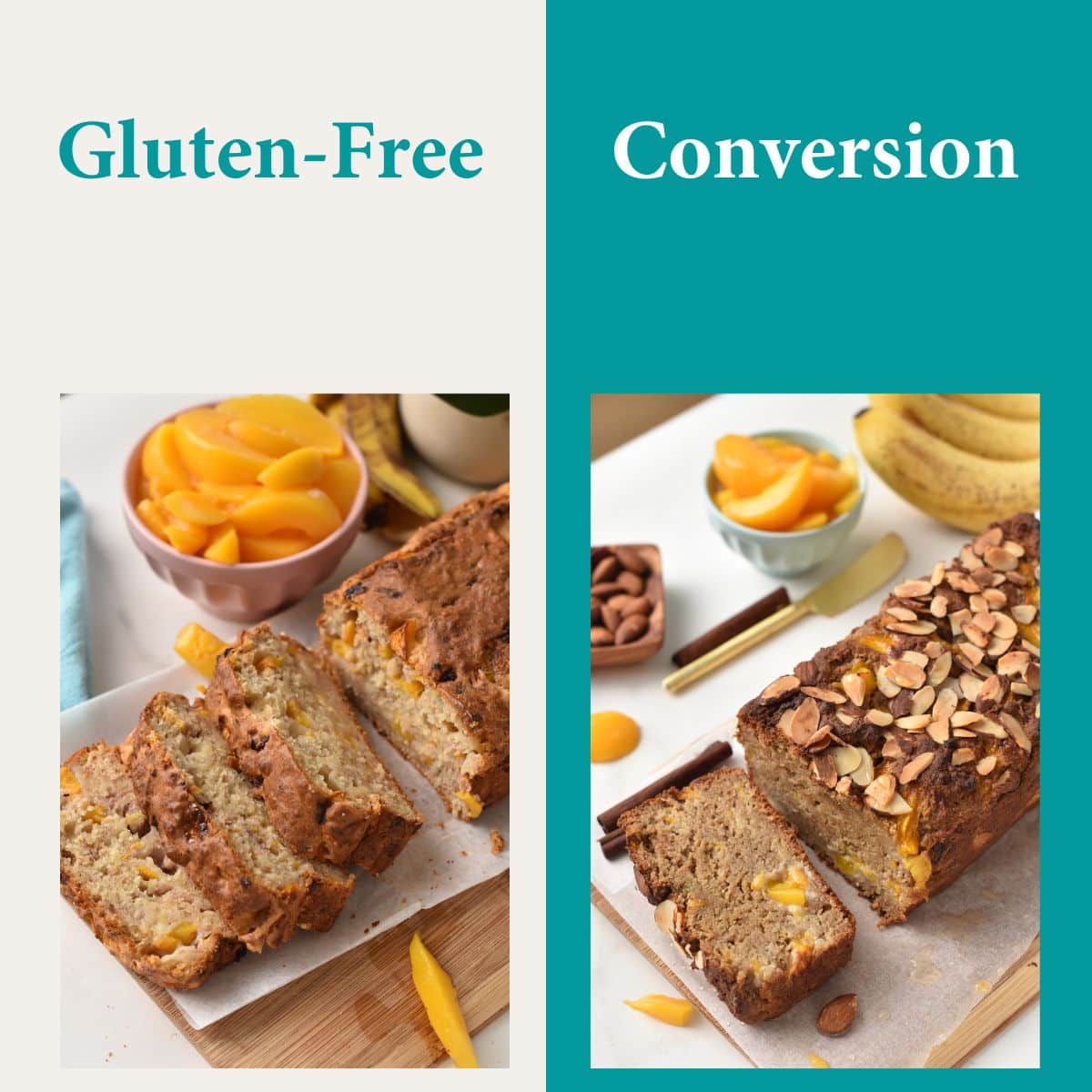
It’s not as simple as just swapping all-purpose flour for all-purpose gluten-free flour. A cake would be gummy, a bagel would be hard as a rock, or brownies would be dense. It’s never a 1:1 ratio because I don’t use eggs in my baking.
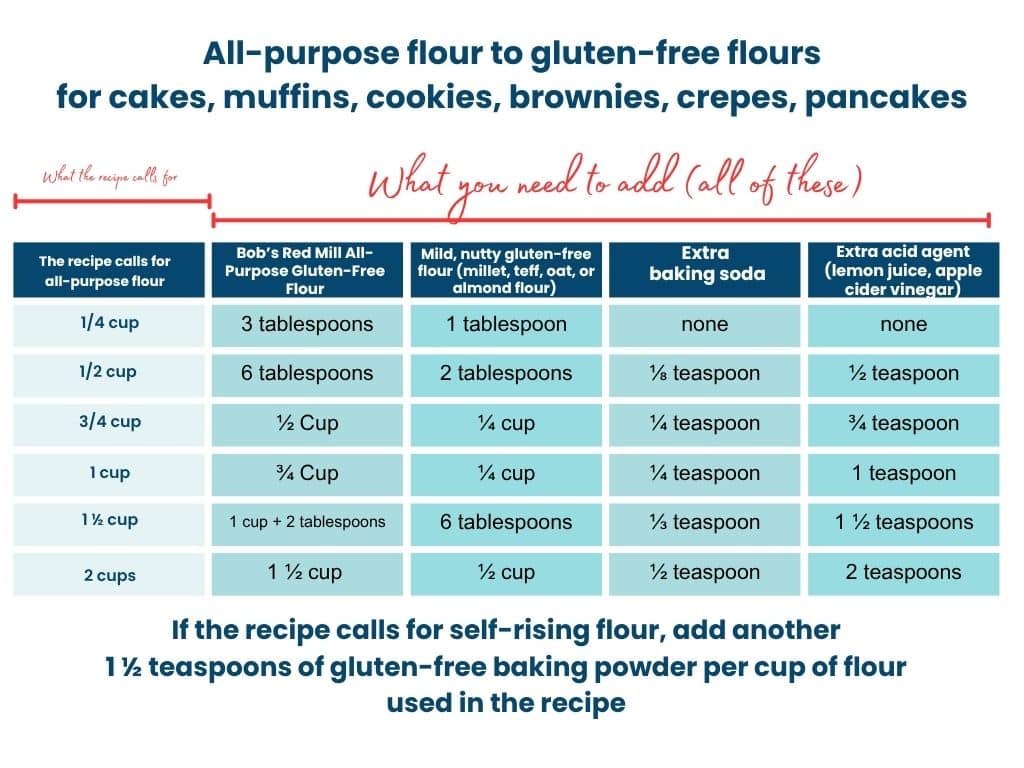
Converting Cakes, Muffins, Brownies, Crepes & Pancakes
When turning a wheat flour recipe into gluten-free, egg-free baking, you need a blend of flours like an all-purpose gluten-free mix and a nutty flour (e.g., teff, millet), along with baking soda and lemon juice. This is due to the absence of gluten and eggs, which are crucial for structure and leavening. Gluten provides elasticity and a framework to trap gases, while eggs contribute protein for structure, fat for richness, and moisture.
In their absence, the all-purpose gluten-free blend offers a base of starches and gums to mimic gluten’s binding properties. Adding nutty flours like millet, teff, or oat flour will add a finer crumb structure, preventing the baked goods from being gummy or too elastic.
Baking soda (a base) and lemon juice (an acid) react to produce carbon dioxide, providing the necessary lift and aeration that eggs would typically contribute, ensuring a lighter, less dense final product.
This combination creates a synergistic effect, compensating for the missing elements to achieve desirable texture and rise.
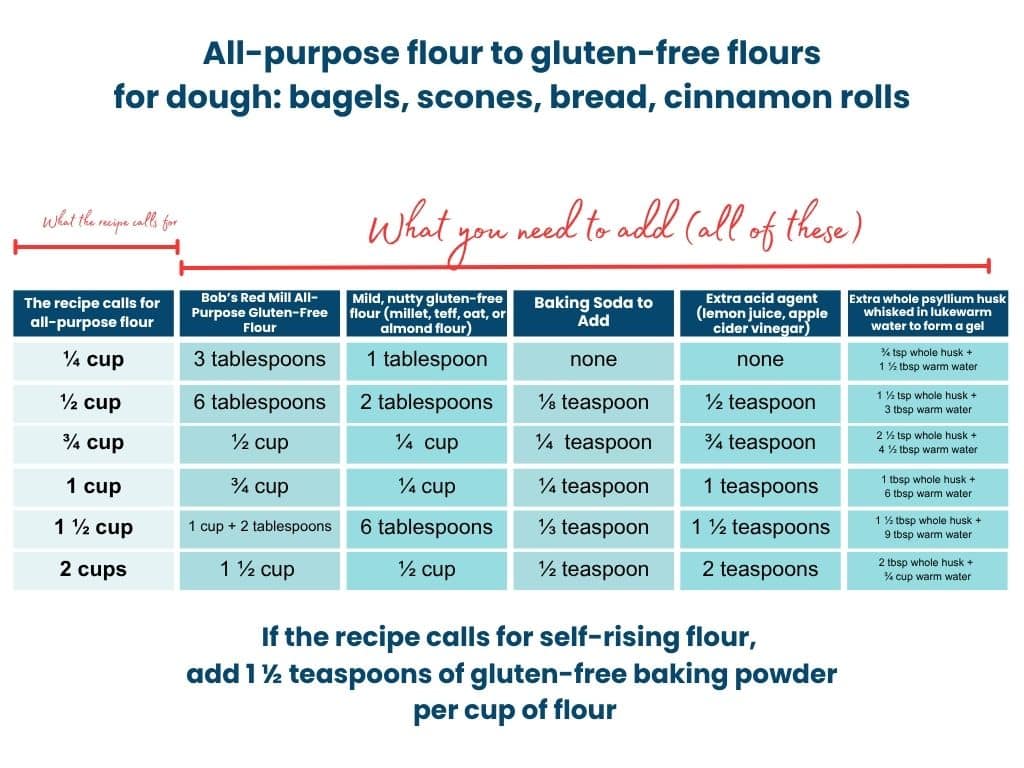
Converting Bread Recipes (Scones, Bagels, Bread, Cinnamon rolls)
For gluten-free, egg-free doughs like bagels, scones, and cinnamon rolls, which inherently rely on gluten for their chewiness and elasticity, the addition of a whole psyllium husk gel is necessary.
Psyllium husk is a powerful hydrocolloid, meaning it absorbs and retains a significant amount of water, forming a stable, sticky, and slightly stretchy gel. You can’t swap this ingredient for flaxmeal or chia seeds. They won’t be able to reproduce the same chewiness at all.
In traditional baking, gluten forms a network that traps gases produced by leavening agents, giving bread its structure and chewiness. Without gluten, these doughs can become crumbly, dry, and dense, lacking the “bite.” The psyllium gel mimics some of gluten’s properties by creating a kneadable dough that can trap air and hold its shape. This gel network also helps bind the gluten-free flours together, preventing a rocky hard and dry result and instead contributing to a soft, moist crumb and the chewiness you want.
Before you start the recipe, measure all your ingredients. Keep the recipe’s liquid ingredients nearby as you will incorporate them into the husk gel immediately.
- First, whisk vigorously the whole psyllium husk and lukewarm water to form a thick gel paste.
- Immediately incorporate any of the remaining liquid ingredients of the recipe, like dairy-free milk, lemon juice, oil, etc.
- Add the wet ingredients to the remaining dry ingredients of the recipe to form the dough.
Ingredients you Need
To make your gluten-free flour mix, you need:
- All-Purpose Gluten-Free Flour: I recommend Bob’s Red Mill Gluten-Free
- Millet Flour: I recommend Bob’s Red Mill Stoneground Millet
- Baking Soda
- Lemon Juice or Apple Cider Vinegar
- Psyllium Husk (for bagels, scones, bread, rolls)
- And to make Self-Rising Flour: Gluten-Free Baking Powder.
What Should I Expect?
With gluten-free flour alternatives, you will get a very similar taste to what you get with wheat flour, however, the texture will be a bit different.
Gluten-free baking will give a slightly denser, slightly gummier texture than regular flour.


Your recipes are delicious and super appetizing.
Thank you.
Also the GF conversion table makes my life a lot easier.
I am so happy to hear that
Hello again, Please give the measurements for how much psyllium gel to add to 1 C. of gluten free flour for bread and, or muffins.
Thank you
Simply use the automatic drop down menu above.
muchas gracias por todo lo que hacés as bendecido mi vida con todas tus recetas
pues por mucho tiempo tuve está intolerante al gluten solo puedo decir gracias Bendiciones por fin volví a comer pan pero saludable,mil gracias
I don’t speak your language, so I will reply in English but this is the most beautiful comment I read this morning. Thank YOU for supporting me here. XOXO Carine
You say you have a cookbook and I would really like to buy it. I have looked everywhere for it. Stores and online. Could you tell me where I can find it please.
I don’t have one yet! It will be published and in store on April 2027
Do you have a book gluten free
My cookbook will be released soon, all the recipes will have a gluten-free option.
Thanks for the gf conversion charts and explanation of why you can’t just switch 1:1
My pleasure!
Hi Carine!
I want to make your 4-ingredient tortillas but would love to make them GF so my partner can enjoy them as well. Would you still recommend to use your flour conversion for tortillas or can I simply replace the regular wheat flour with GF cup-for-cup flour? I’m using King Arthur Measure for Measure flour which is: rice flour, whole grain brown rice flour, sorghum flour, tapioca starch, potato starch, cellulose gum and xanthan gum.
Many thanks for your help!
Jess
Hi Jess, for all my recipes you must use my gluten-free converter. The 1:1 statement you see on gluten-free flour bags are for classic recipes with eggs. Because mine are egg-free you must adapt the blend. For tortillas use the converter for bread, using the added husk to add a real chewy texture to the tortillas.
Hi there! First of all, THANKS for your time, love & dedication!!!
I’m gonna try the tofu scones (!!!) but i don’t understand one thing (sorry if my questions are stupid, i’m from spain and my english is not as well as i’d desire )
The original recipe calls for 2 cups of self rising flour and the converter asks for:
1 1/2 cups of GF Flour Blend.
And then more ingredients that make more than 2 cups, so i guess the substitution it’s not 1:1 ok??
And what is GF Flour Blend? Can i use 1 ½ cup of any gf flour like rice, buckwheat, oat, almond???
Have a nice week!
Yes, the swap doesn’t match the same volume especially for scone where husk is added and water is needed to activate the husk. Gluten-free flour blend is defined above it’s a bag of all-purpose gluten-free flour brand bob red mills. It’s definitely not buckwheat, rice or almond! Enjoy.
Thanks!!!!!!
Aamm this one??
https://www.bobsredmill.com/product/gluten-free-all-purpose-baking-flour
Thanks!
No, the blue bag it contains added gums that firm up the baked goods better.
Hello Carine, thank you for these ideas! I just wanted to clarify about the gluten-free recommendations for making gluten-free self rising flour for Yogurt Bread. Are you saying that we need to add 1 cup +2 tablespoons of water to the recipe, along with the 1.25 cups of Soy Milk?
The yogurt bread requires 3 cups self-rising flour. In this tool, select the type of recipe you convert ‘bread’ then select the amount to convert ‘3 cups’, then in the field What type of flour does the recipe call for? select ‘self-rising flour’ then read the result below. What you read is what you use instead of the flour in the original recipe. Then, of course, you still add the remaining ingredient from the original recipe. So your gluten-free flour mix is 2 1/4 cups of GF Flour Blend:
3/4 cup of Mild, Nutty Flour (like Almond, Millet, Teff flour)
3/4 tsp of Baking Soda
3 tsps of Acid (Lemon/Vinegar)
3 Tbsps of Whole Psyllium Husk
1 cup + 2 Tbsps of Water
4 1/2 tsps of Extra Baking Powder
In this you add the remaining ingredients from the recipe: 1 cup Dairy-Free Yogurt, ¼ cup Olive Oil, 1 ¼ cups Soy Milk
When you say ‘extra baking powder’ in the converter tool for GF baking, does it mean more than what the original recipe calls for? For example if the original recipe says ‘3 tsp baking powder’ when you say extra in the gf conversion would it amount to a total of 6 teaspoons of baking powder?
I’ve asked this question before and I didn’t get any response via email or here. So I thought I’d as again.
The extra baking powder adds up to the one already present in the original recipe, if some is already present. So yes, if the recipe already shows 2 tsp baking powder, and the converter says 2 extra teaspoon then the total is 4 teaspoons