

I’ve developed a method to convert all my baking recipes with all-purpose flour (or self-rising flour) into gluten-free recipes. You only need to make a few adjustments to enjoy all the taste and almost the same texture in all my muffins, bread, scones, brownies, and cakes!
You must adjust the recipe according to the instructions provided below.
Gluten-Free Flour Conversion Tool
Determine the exact mixture to replace wheat flour with a customized GF blend.
1. Select Recipe Type
2. Wheat Flour Amount to Replace
3. What type of flour does the recipe call for?
Your Gluten-Free Flour Mixture
You need all of the below:
Select your options above to see the required ingredients.
* Amounts are rounded for practical use. Smallest measurable US amount is 1/8 tsp.
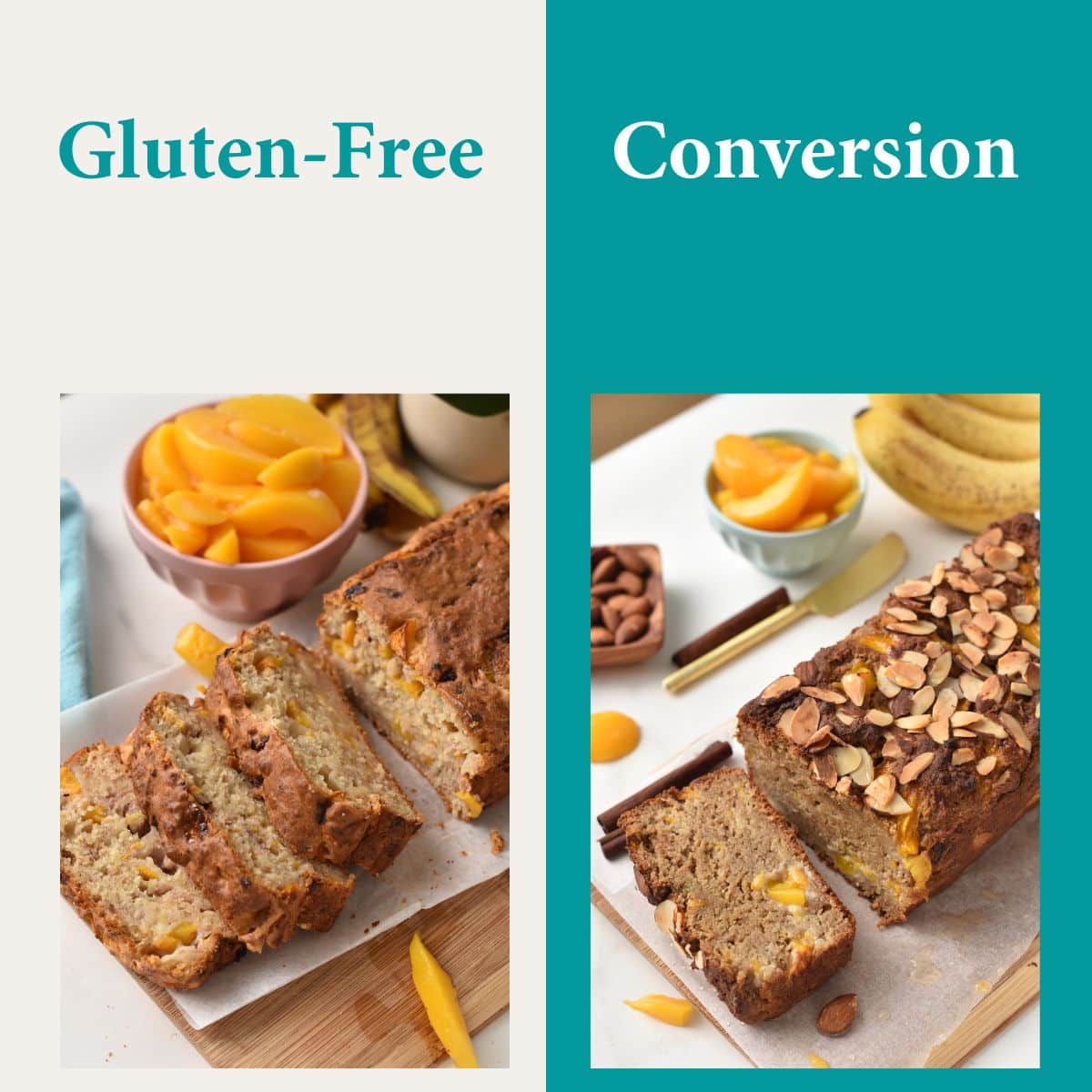
It’s not as simple as just swapping all-purpose flour for all-purpose gluten-free flour. A cake would be gummy, a bagel would be hard as a rock, or brownies would be dense. It’s never a 1:1 ratio because I don’t use eggs in my baking.
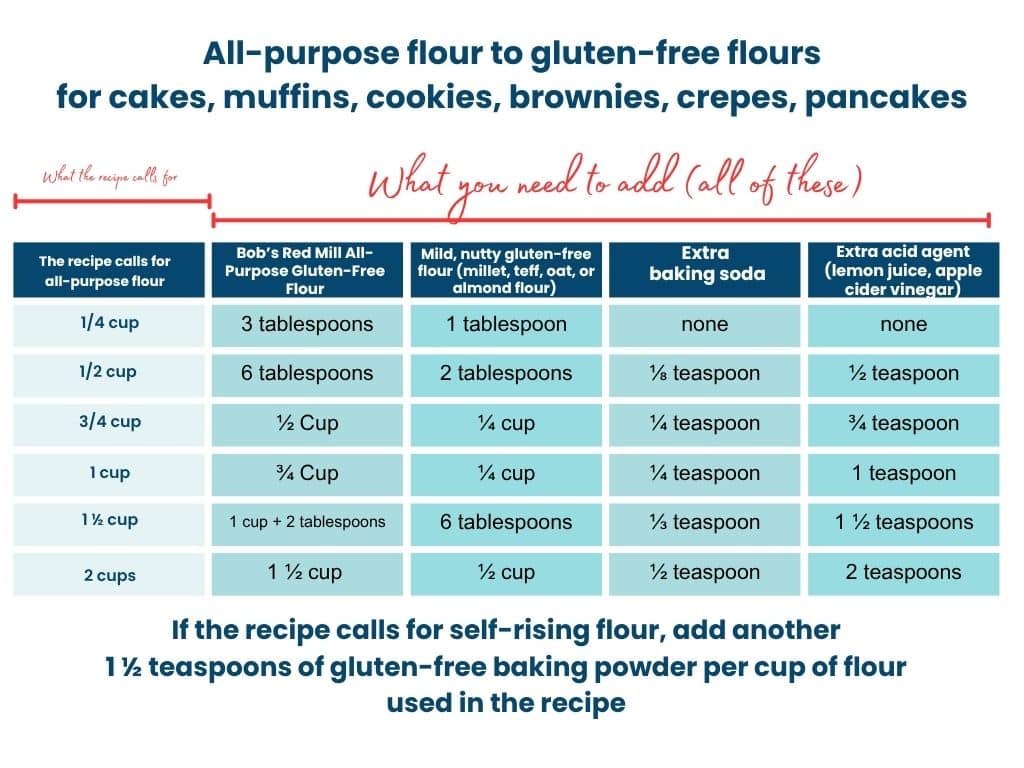
Converting Cakes, Muffins, Brownies, Crepes & Pancakes
When turning a wheat flour recipe into gluten-free, egg-free baking, you need a blend of flours like an all-purpose gluten-free mix and a nutty flour (e.g., teff, millet), along with baking soda and lemon juice. This is due to the absence of gluten and eggs, which are crucial for structure and leavening. Gluten provides elasticity and a framework to trap gases, while eggs contribute protein for structure, fat for richness, and moisture.
In their absence, the all-purpose gluten-free blend offers a base of starches and gums to mimic gluten’s binding properties. Adding nutty flours like millet, teff, or oat flour will add a finer crumb structure, preventing the baked goods from being gummy or too elastic.
Baking soda (a base) and lemon juice (an acid) react to produce carbon dioxide, providing the necessary lift and aeration that eggs would typically contribute, ensuring a lighter, less dense final product.
This combination creates a synergistic effect, compensating for the missing elements to achieve desirable texture and rise.
Converting Bread Recipes (Scones, Bagels, Bread, Cinnamon rolls)
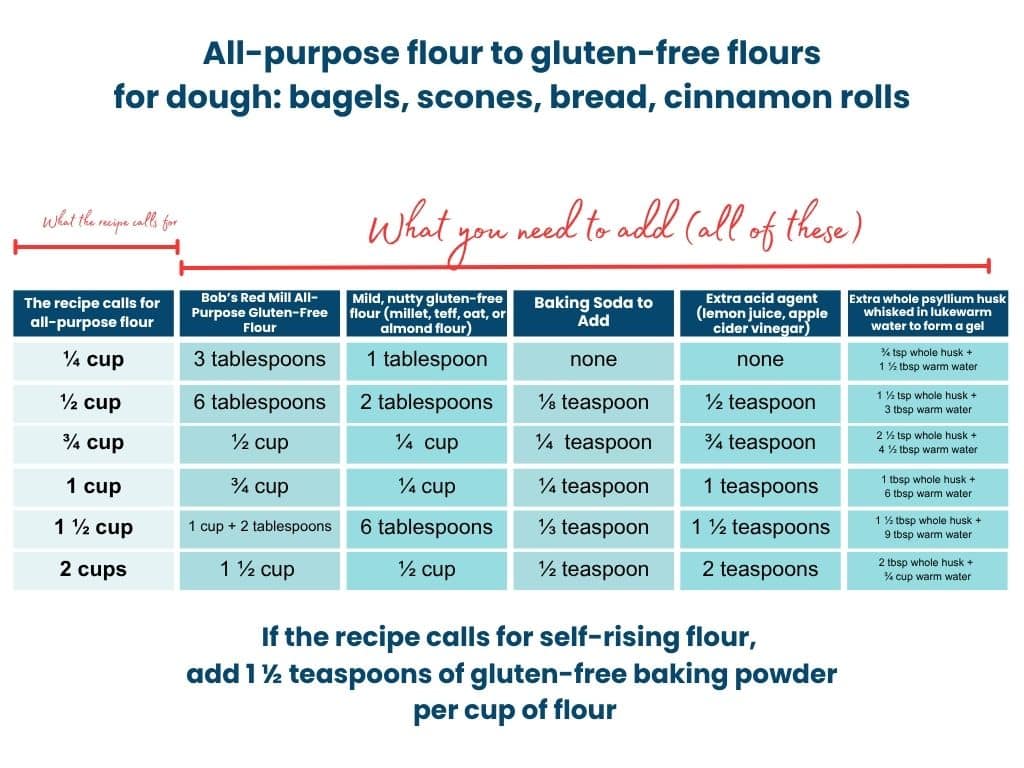
For gluten-free, egg-free doughs like bagels, scones, and cinnamon rolls, which inherently rely on gluten for their chewiness and elasticity, the addition of a whole psyllium husk gel is necessary.
Psyllium husk is a powerful hydrocolloid, meaning it absorbs and retains a significant amount of water, forming a stable, sticky, and slightly stretchy gel. You can’t swap this ingredient for flaxmeal or chia seeds. They won’t be able to reproduce the same chewiness at all.
In traditional baking, gluten forms a network that traps gases produced by leavening agents, giving bread its structure and chewiness. Without gluten, these doughs can become crumbly, dry, and dense, lacking the “bite.” The psyllium gel mimics some of gluten’s properties by creating a kneadable dough that can trap air and hold its shape. This gel network also helps bind the gluten-free flours together, preventing a rocky hard and dry result and instead contributing to a soft, moist crumb and the chewiness you want.
Before you start the recipe, measure all your ingredients. Keep the recipe’s liquid ingredients nearby as you will incorporate them into the husk gel immediately.
- First, whisk vigorously the whole psyllium husk and lukewarm water to form a thick gel paste.
- Immediately incorporate any of the remaining liquid ingredients of the recipe, like dairy-free milk, lemon juice, oil, etc.
- Add the wet ingredients to the remaining dry ingredients of the recipe to form the dough.
Ingredients you Need
To make your gluten-free flour mix, you need:
- All-Purpose Gluten-Free Flour: I recommend Bob’s Red Mill Gluten-Free
- Millet Flour: I recommend Bob’s Red Mill Stoneground Millet
- Baking Soda
- Lemon Juice or Apple Cider Vinegar
- Psyllium Husk (for bagels, scones, bread, rolls)
- And to make Self-Rising Flour: Gluten-Free Baking Powder.
What Should I Expect?
With gluten-free flour alternatives, you will get a very similar taste to what you get with wheat flour, however, the texture will be a bit different.
Gluten-free baking will give a slightly denser, slightly gummier texture than regular flour.


Thanks Carine! Really well explained. I’ve been looking for GF recipes but have not found explanations of the why.
These conversions I’m sure will come in useful as I’ve not known how to sub gf flours in a ‘normal’ recipe.
This gives me hope I can play around with recipes.
Grateful, Anne
Hi Anne, I look forward to hear your feedback on the first recipe you will make using the gluten-free converter!
Can I use an egg in the bread/ bagel recipes? if so what can I leave out?
I have no idea, I don’t bake with eggs.
What about cookies? Will these tips work.
Yes, first row says :Cakes, Muffins, Brownies, Crepes, Pancakes, Cookies, etc. (Less structure)
Hello! I used all gluten free flour. It’s supposed to be an equal conversion to wheat flour. However, the scones didn’t rise. I later saw your conversion table. Rats! I”ll still eat my flat scones, but I look forward to making them taste better next time.
In egg-free baking, you can’t use gluten-free flour as a 1:1 swap to flour, even if the packaging says it’s a 1:1 flour, this is only true for recipes with eggs! For my recipes, it’s crucial to use my gluten-free converter.Let me know how it goes.
this is very interesting to read thank you for your output forme just learning of how to make gluten free dessert
I am so happy you enjoy this!
What if you are using Casava flour instead of wheat flour? What’s the conversion?
I never baked with cassava flour before, it’s not available in my country so I can’t recommend I am sorry.
I would like to make your Guinoa Bread Rolls using Bob’s Red Mill 1 to 1 gluten free
flour. The company claims that you can swap out wheat flour cup per cup with this flour. If I use it, besides the baking powder, do I still have to add the other things from your GF conversion tool?
what you see on the packaging is a recommendation for recipe using eggs. Since my recipes are egg-free, 1:1 swaps never provides a great texture, and that’s why you need my gluten-free chart. In the chart, you select if you are converting a recipe using regular flour, or self-rising flour. It means the result the converter gives you already includes any extra baking powder. All you need then is to add all the remaining recipe ingredient, expect the flour.
Hi! I am so excited to do the apple sauce GF scones. I followed your advice and I came to the conversion tool. If the recipe calls for 2 cups of flour and I am “converting” do I double the amounts on the conversion? Thanks a lot for your help. I have Celiac Disease, so your recipes are literally “heaven”
If the recipe calls for 2 cups, select 2 cups in the drop down menu. If you want to make scones, tick the scone option. If the original recipe use self-rising flour tick self-rising flour. Then scroll down and you will get the eact gluten-free mi you have to create to make the scones. I copy paste below the answer for the applesauce scones: Your Gluten-Free Flour Mixture
You need all of the below:
1 1/2 cups of Gluten-Free Flour Blend (e.g., rice/tapioca/potato starch base)
1/2 cup of Mild, Nutty Flour (e.g., millet, teff, oat, or almond flour)
1/2 tsp of Baking Soda
2 tsps of Acid (Lemon Juice or Apple Cider Vinegar)
2 Tbsps of Whole Psyllium Husk
3/4 cup of Water (to activate psyllium)
3 tsps of Extra Baking Powder (for self-rising conversion)
Hello. I’d like to confirm before trying out the Beer bread that the conversions I’ve written down are accurate. So to replace the 3 cups of self rising AP flour I would use: 2 1/4 cup GF blend + 3/4 cup oat or almond flour + 3/4 tsp baking soda + 3 tsp acid + 3 tbsp whole psyllium husk + 4 1/2 tsp baking powder. If you could verify please that this combo looks accurate I’d greatly appreciate it. Btw, I make the quinoa bagels all the time and my husband loves them! Thank you! 🙂
Hello I’d really like to try your strawberry bread but I only have coconut flour. what would the conversion be?
Coconut flour never work well in egg-free baking recipes. It’s a high fiber, low starch flour that needs eggs as a binder or the food come out ultra dry, fragile and crumble apart.
No, that’s not correct you are mixing the extra water, and baking powder. If you use my automatic tool, select, bread, self-rising flour, 3 cups and here’s the mix it gave you in the table below.
2 1/4 cups of Gluten-Free Flour Blend (e.g., rice/tapioca/potato starch base)
3/4 cup of Mild, Nutty Flour (e.g., millet, teff, oat, or almond flour)
3/4 tsp of Baking Soda
3 tsps of Acid (Lemon Juice or Apple Cider Vinegar)
3 Tbsps of Whole Psyllium Husk
1 cup + 2 Tbsps of Water (to activate psyllium)
4 1/2 tsps of Extra Baking Powder (for self-rising conversion)
Hi Carine. I didn’t receive an email notifying me that you responded to my comment even though I marked the box. Thank you for replying… I figured with the water and a bottle of beer it would be too much moisture. If I’m understanding correctly, the remaining ingredients for the beer bread in addition to all that u listed from the GF tool would be: 12 oz beer, 3 tbsp olive oil, 1 tbsp sugar, salt? I’m sorry that I’m just not sure I’m fully interpreting this accurately. Have you made the beer bread gluten free? Thank you for your help and advice.
Here the exact quantities you need to make the beer bread gluten-free:
Ingredients: 2 1/4 cups of Gluten-Free Flour Blend (e.g., rice/tapioca/potato starch base)
3/4 cup of Mild, Nutty Flour (e.g., millet, teff, oat, or almond flour)
3/4 tsp of Baking Soda
3 tsps of Acid (Lemon Juice or Apple Cider Vinegar)
3 Tbsps of Whole Psyllium Husk
1 cup + 2 Tbsps of Water (to activate psyllium)
4 1/2 tsps of Extra Baking Powder (for self-rising conversion),
12 fl. oz Light Blonde Beer
3 tablespoons Mild-Flavor Olive Oil
Hi….I’d love to try this recipe. The flour I have is Bob’s Red Mill 1:1, which has xanthan gum in it…is that considered self-rising? Would it work?
It’s considered regular gluten-free flour, self-rising flour has baking powder added in the mix. But it’s all fine because when you use my gluten-free conversion tool, you need regular gluten-free flour blend, not a self-rising flour blend. Simply make sure you select self-rising flour IF you are converting a recipe using self-rising flour, or select flour, if using a recipe using flour.